Understanding Mortgage Pre-Approval The holiday season is upon us, and while you may be busy…
Conventional vs. Non-QM Loans: Which Option Fits Borrowers With Complex Income?
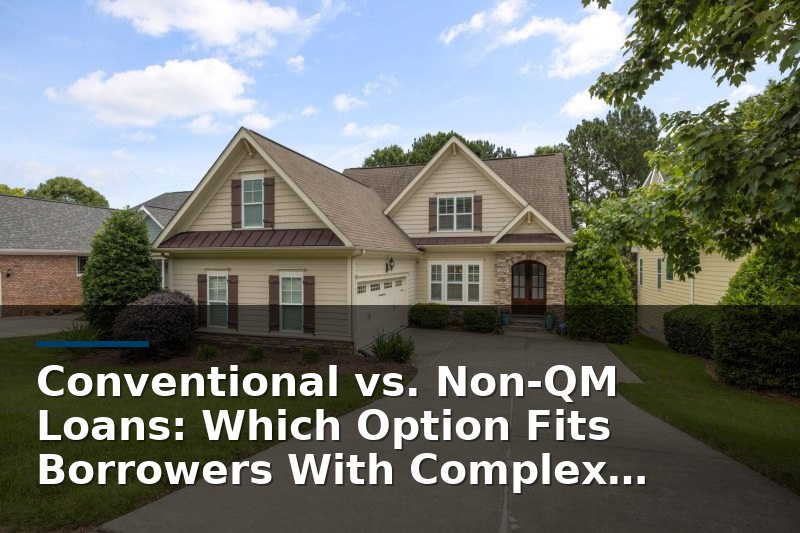
Having strong income doesn’t always mean that income fits neatly into conventional mortgage guidelines.
Conventional loans typically verify income through standard tax and employment documents, while Non-QM loans may use alternative methods such as bank statements, assets, or profit-and-loss statements.
In this guide, I’ll explain how these loans differ, what lenders review, and how borrowers with complex income can compare their options.
Key Takeaways
- Income Review: Conventional loans usually rely on standard income calculations, while Non-QM programs may allow alternative documentation.
- Qualification: Credit, assets, debts, property type, reserves, and overall risk still matter under both loan structures.
- Tradeoff: Non-QM loans may provide more flexibility, but they commonly carry higher rates, larger down payment expectations, or additional reserve requirements.
- Best For: Non-QM financing may fit self-employed borrowers, real estate investors, and borrowers whose documented income doesn’t reflect their full financial picture.
I’m David Goldberg (NMLS# 728872), VP of Mortgage Lending with The Goldberg Mortgage Team, and I’ve worked in mortgage lending for 24 years. I came into the business unexpectedly after a layoff and a newspaper ad led me to an interview, but I quickly found that I enjoyed helping people finance one of their largest investments.
Quick Answers
- What is the main difference? Conventional loans generally follow standardized agency guidelines, while Non-QM programs use investor-specific guidelines that may accept different ways of documenting income.
- Does Non-QM mean bad credit? No. Non-QM describes how a loan is underwritten, not the quality of the borrower or the loan.
- Can complex income still qualify conventionally? Yes. A borrower may have multiple income sources and still qualify if the income can be documented, calculated, and shown to be reasonably stable.
- Are Non-QM rates the same as conventional rates? Usually not. Non-QM pricing varies by program and commonly reflects the additional flexibility offered by the loan.
- Can Non-QM be used for purchases and refinances? Often, yes. Availability depends on the borrower, property, occupancy, equity, and current investor guidelines.
What Is a Conventional Loan?
A conventional loan is a mortgage that isn’t insured or guaranteed by a government agency. Many conventional loans follow guidelines established by Fannie Mae or Freddie Mac, although some conventional loans fall outside those agency programs.
For borrowers with straightforward income, the process can be fairly clear. A lender may review W-2 forms, pay stubs, tax returns, employment history, and other standard documents.
Self-employed income can also qualify for a conventional loan. The calculation is simply different.
A lender commonly starts with personal and business tax returns. From there, the underwriter reviews net income, recurring business expenses, ownership percentage, income trends, and permitted adjustments.
This is where borrowers sometimes get surprised.
A successful business can generate strong cash flow, but deductions that reduce taxable income can also reduce the income available for conventional mortgage qualification. Money coming into the business account isn’t automatically treated as personal qualifying income.
What Is a Non-QM Loan?
A Non-QM loan is a mortgage that falls outside the federal Qualified Mortgage standards and may use alternative underwriting methods. It isn’t an approval without documentation, and it isn’t automatically a loan for someone with poor credit.
Non-QM lenders still evaluate the borrower’s ability to repay the loan. They may simply evaluate it through a different set of documents.
Depending on the program, those documents may include:
- Personal or business bank statements
- A profit-and-loss statement
- 1099 income
- Liquid assets used to calculate monthly qualifying income
- Rental property cash flow
- Standard income documents combined with alternative income sources
These programs aren’t uniform. One Non-QM investor may accept a particular income method while another does not. Credit standards, reserve requirements, eligible property types, and down payment expectations can also differ.
For a broader look at these programs, review the available Non-QM loan options.
Conventional vs. Non-QM Loans at a Glance
| Feature | Conventional Loan | Non-QM Loan |
|---|---|---|
| Income documentation | Usually tax returns, W-2s, pay stubs, and standard employment records | May include bank statements, assets, 1099s, or profit-and-loss statements |
| Guideline source | Often follows Fannie Mae or Freddie Mac guidelines | Follows the guidelines of the specific lender or investor |
| Pricing | Commonly lower than comparable Non-QM pricing | Commonly higher because of added underwriting flexibility |
| Loan limits | Conforming limits vary by county; loans above them may require jumbo financing | Maximum loan amounts vary by program and investor |
| Typical fit | Borrowers whose income works under standard calculations | Borrowers with reliable finances that require alternative documentation |
Rates, fees, loan amounts, and underwriting requirements change. Current terms should always be verified for the specific borrower, property, and program.
Why Complex Income Can Be Difficult Under Conventional Guidelines
Complex income isn’t necessarily unstable income. It may simply require more analysis than a standard salary.
Common examples include:
- Business owners who take significant tax deductions
- Borrowers with several businesses or income streams
- Commission income that changes from year to year
- Real estate investors with multiple financed properties
- Borrowers receiving 1099 income
- Borrowers with substantial assets but limited recurring taxable income
- People who recently changed the legal structure of an established business
A conventional underwriter generally needs to establish that qualifying income is documented, stable, and likely to continue. That analysis may involve averaging income, accounting for declining earnings, or excluding income that doesn’t meet the applicable history and continuance rules.
Agency requirements are only one part of the review. Individual lenders may add overlays that are more restrictive than the underlying agency guideline.
That distinction matters.
A conventional application that doesn’t fit one lender’s overlay may work with another lender. It also may not require Non-QM financing at all.
How Alternative Income Documentation Works
Bank Statement Programs
A bank statement loan estimates qualifying income by reviewing eligible deposits over a specified period. Depending on the program, the lender may use personal statements, business statements, or both.
Business deposits aren’t usually counted dollar for dollar as personal income. The lender may apply an expense factor or use other documentation to estimate the portion of deposits available to the borrower.
Transfers between accounts, loan proceeds, tax refunds, and other non-income deposits may be excluded. Large or unusual deposits may need an explanation.
Borrowers considering this route can read more about the bank statement mortgage program.
Asset-Based Qualification
Some Non-QM programs convert eligible assets into a calculated monthly income amount. The calculation may consider the type of asset, the borrower’s age, the loan term, and whether funds are also needed for the down payment, closing costs, or reserves.
Not every asset is treated the same way. Retirement assets, cash accounts, and invested funds may receive different treatment, and borrowed funds generally don’t serve the same purpose as owned assets.
Profit-and-Loss or 1099 Programs
Certain programs may use a profit-and-loss statement, 1099 forms, or a combination of documents. The lender may require supporting bank statements, a tax professional’s involvement, or evidence that the business has operated for a sufficient period.
The details vary widely by investor. A document accepted under one program may not satisfy another program’s requirements.
Rental Property Cash Flow
Real estate investors may have an option that places greater weight on the property’s expected rental income than on personal income.
A DSCR loan program compares qualifying property income with the property’s required debt payments. Property eligibility, appraisal findings, lease documentation, reserves, and investor rules still apply.
Which Loan Structure Makes the Most Sense?
Start with the conventional calculation whenever it’s realistic. Conventional financing may offer better pricing and lower reserve or down payment expectations than a Non-QM alternative.
But don’t stop at the tax return.
Let’s look at the whole picture. That includes credit, liquid assets, business cash flow, current debts, property type, occupancy, future plans, and the amount of cash the borrower wants to keep after closing.
Not every borrower fits neatly into the standard mortgage box.
A Non-QM loan may make sense when the borrower has the financial ability to manage the mortgage, but the conventional income calculation doesn’t tell the full story. The added cost may be reasonable if the structure supports a larger financial plan, but that needs to be evaluated carefully.
Questions to Compare Before Choosing
I would compare more than the interest rate. A lower rate doesn’t automatically make a loan the better fit if the borrower can’t qualify under that program or if it requires a financial move that doesn’t make sense.
Review these questions:
- How much income is usable under conventional guidelines?
- Which deposits or assets are eligible under the Non-QM program?
- How much cash is needed for the down payment and closing costs?
- How many months of reserves will remain after closing?
- Is there a prepayment penalty, and is one permitted for the occupancy type?
- How do the monthly payment and total closing costs compare?
- Does the property meet the program’s eligibility rules?
- Is the borrower planning to keep the loan long term or refinance if circumstances change?
Borrower eligibility and property eligibility are separate. Strong income and credit won’t fix a property that falls outside the chosen program’s rules.
The reverse is also true. An eligible property doesn’t establish that the borrower qualifies.
Planning for a Pre-Approval With Complex Income
A pre-approval for complex income usually starts with more documents, not fewer. Gathering information early gives the lender time to compare calculations before a purchase contract creates a deadline.
Helpful documents may include:
- Recent personal and business bank statements
- Personal and business tax returns
- Year-to-date profit-and-loss statements
- Business balance sheets
- 1099 forms and related contracts
- Current mortgage statements and lease agreements
- Statements for investment and retirement accounts
- Business ownership documentation
The final list depends on the loan. Providing every available document isn’t always necessary, but providing the right documents is.
For borrowers in Greater Cleveland, that review may involve conforming loan limits that differ by county, property considerations, and local tax or insurance costs. The same planning applies in Cuyahoga County, Lake County, Geauga County, Summit County, Lorain County, and Medina County, as well as for borrowers I help nationwide.
Let’s Compare the Options
Complex income often requires a side-by-side review rather than a quick answer.
The Goldberg Mortgage Team can compare conventional and Non-QM structures, explain the documentation each one requires, and review the tradeoffs in plain language. Call, text, or email us to discuss your scenario, prepare for pre-approval, and understand the next steps.
Frequently Asked Questions
Can a Non-QM loan finance a primary residence, second home, or investment property?
Potentially, yes. Eligible occupancy types vary by program, and each one may have different down payment, reserve, pricing, and property requirements.
Can I refinance a Non-QM loan into a conventional loan later?
It may be possible if you meet conventional guidelines at that time and the property qualifies. Future approval, rates, property value, equity, and loan availability can’t be assumed, so the original loan should make sense without relying on a future refinance.
How are business expenses handled with a bank statement loan?
Lenders commonly apply an expense factor to eligible business deposits or review supporting documentation to estimate business expenses. The method and permitted exceptions vary by investor and business type.
Can a co-borrower’s income be combined with alternative income documentation?
Some programs allow income from multiple borrowers, including a combination of standard and alternative documentation. The exact treatment depends on the relationship to the business, account ownership, occupancy, and program guidelines.
What should I prepare before requesting a complex-income pre-approval?
Start with recent income, asset, debt, and business documents, along with a clear explanation of how you earn money. An early review can identify whether conventional calculations work or whether an alternative documentation program should be compared.
This is educational and not financial advice. Loan programs and guidelines can change. Talk with a licensed mortgage professional about your specific scenario.

About the Author
David Goldberg
VP of Mortgage Lending at The Goldberg Mortgage Team · NMLS #728872
David Goldberg, a Cleveland based mortgage expert who helps first-time buyers, move-up homeowners, self-employed borrowers, real estate investors, Physicians, Veterans, and retirees find creative mortgage solutions throughout Northeast Ohio, Southeast Florida, and across the entire US. David has led The Goldberg Mortgage Team powered by Mutual of Omaha Mortgage since 2004.
Specializes in: Non-QM, Jumbo, Conventional
Licensed in: AL, AK, AZ, AR, CA, CO, CT, DE, FL, GA, HI, ID, IL, IN, IA, KS, KY, LA, ME, MD, MA, MI, MN, MS, MO, MT, NE, NV, NH, NJ, NM, NC, ND, OH, OK, OR, PA, RI, SC, SD, TN, TX, UT, VT, VA, WA, WV, WI, WY
Related Posts